Homeopathic treatment
Before delving into homeopathic treatment let us first discuss the conventional or allopathic treatment available.
The conventional or allopathic treatment of pityriasis versicolor or tinea versicolor,
like any other skin disease, is the local application of various ointments, shampoos
and so on.
In the conventional or allopathic treatment the medicines used for treating (better
saying suppressing) the condition are clotrimazole cream or lotion, selenium sulfide
lotion shampoo. Some allopathic doctors may also recommend Selsun or Nizoral shampoo
to be applied on the affected areas.
The various side effects caused by these drugs are:
- Skin irritation, redness, swelling.
- Blackening of skin.
The oral anti fungal drugs used are ketoconazole or griseofulvin. Allopathic medications
for fungal infections are often strong, and their use may cause such undesirable
side effects as headache, dizziness, nausea, vomiting, or abdominal pain.
In contrast homeopathic treatment does not advocate the use of creams and ointments
in skin disorders. It believes that skin disorders are a reflection of internal
problem and need to be treated from within. External application (creams, ointments)
can lead to the suppression of the disease and result in a more serious systemic
disorder.
A person having pityriasis versicolor or tinea versicolor is always embarrassed
due to the ugly looking rashes and itching which creates difficulties if the patient
is out of home in a gathering. Magical doses of homeopathic medicines can ease a
patient with itching as well as with the embarrassing skin rashes.
Skin disorders are a reflection of disturbance within the body, be it lowered immunity
or increased secretions of sebum and sweat glands which makes the skin more prone
to the fungal infections.
The homeopathic remedies aim to cure the internal dishormony and the cause behind
the apparent disease. I usually select a medicine considering the emotional state of
the patient, the probable causative factors (physical or mental), general state
of body and all the diseased symptoms of the body. By raising the immunity of the
body same medicine is capable of eradicating various diseases present in the body
at a time.
While choosing the remedies I also take into consideration the various factors for example,
genetic predisposition, poor immune system, summer aggravation and so on. Homeopathy
treatment, which gets to the root of the problem will reinforce the immune system
and gradually restore the normal skin color and texture.
There are 71 homeopathy medicines which give great relief. However, the correct
choice and the resulting relief is a matter of experience and right judgment on
the part of the doctor. The treatment is decided after thorough case taking of the
patient. Thus remedies of pityriasis versicolor or tinea versicolor or dermatomycosis
furfuracea are designer made unlike allopathy in which all patients receive the
same drugs although trade name may be different.
For online treatment, you may follow the following steps at Consult now.
*DISCLAIMER: There is no guarantee of specific results and the results can vary. None of the remedies mentioned including services, mentioned at HomeopathicTreatment4U.com, should be used without clearance from your physician or healthcare provider. We do not claim to cure any disease which is considered 'incurable' on the basis of scientific facts by modern medicine. We assure you of the best possible efforts for those who apply for online treatment. However, please note that we do not claim to cure each and every case, nor do we guarantee any magical cure. The website’s content is not a substitute for direct, personal, professional medical care and diagnosis.
What is pityriasis versicolor or tinea versicolor or fungal infection or dermatomycosis
furfuracea
Lorem ipsum dolor sit amet, consectetur adipisicing elit, sed do eiusmod tempor
incididunt ut labore et dolore magna aliqua. Ut enim ad minim veniam, quis nostrud
exercitation ullamco laboris nisi ut aliquip ex ea commodo consequat.

Causes
Pityriasis versicolor or tinea versicolor is caused by a yeast-like germ called
malassezia (also called pityrosporum). Small numbers of this germ commonly live
on the skin, and do no harm. However, some people are prone to this germ multiplying
on their skin more than usual, which then leads to a rash developing.
Symptoms
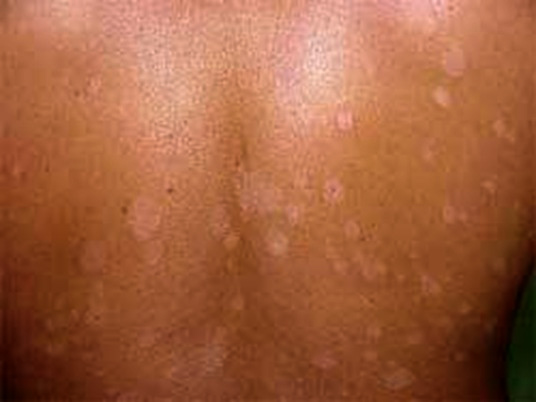
- Generally oval or irregularly-shaped spots of 1/4 to 1 inch (0.6 to 2.5 cm) in diameter,
often merging together to form a larger patch.
- Occasional fine scaling of the skin producing a very superficial ash-like scale.
- Pale, dark tan, or pink in color, with a reddish undertone that can darken when
the patient is overheated, such as in a hot shower or during / after exercise.
- Sharp border.
- Sometimes severe 'pin-prick' itching in the affected areas; usually when the person's
body temperature is elevated by exercise or a hot / warm environment, but the person
hasn't started sweating yet. Once sweating begins the 'pin-prick' itching stops.
These spots commonly affect the back, underarm, upper arm, chest, lower legs, and
neck. Occasionally it can also be present on the face.
In people with dark skin tones, pigmentary changes such as hypopigmentation (loss
of color) are common, while in those with lighter skin color, hyperpigmentation
(increase in skin color) are more common. These discolorations have led to the term
'sun fungus'.
In summers the infection is seen as well-defined, uneven patches. The patches are
pale red or brownish, and scaly. The patches often merge into big blotches that
may look like maps. Sun bathing evens out the color and makes the condition less
visible.
In autumn the patches become scaly and change color. In people who have tanned skin,
this stage is quite visible as these patches appear white. It is at this point that
most people first consult their doctor.
Risk factors
People who are at risk for tinea versicolor or pityriasis versicolor are:
- People who suffer from profuse sweating or high production of sebum, for instance
teenagers.
- People with an immunodeficiency following diabetes, Cushing’s syndrome.
- People on medications such as corticosteroids.
- Genetic predisposition.
Diagnosis
Microscopic examination of the scales after dissolving in potassium hydroxide reveals
the branched hyphae and round spores of the yeast, the classic spaghetti and meatball
appearance.