Homeopathic treatment
Every tennis player dreads 'tennis elbow' or lateral epicondylitis, which often
starts trying out a new racket, stringing a racket too tightly, or playing too eagerly
after an injury. Some other activities that put excessive or repetitive stress on
tendon attachments in the elbow include golfing, weight training, pitching balls,
hanging wall paper, painting ceilings, cooking and so on.
Allopathic or conventional mode of treatment is usually started off conservatively
and work up to more involved treatments. In allopathy the doctors prescribe oral
anti inflammatory medications to help control pain and inflammation. Cortisone injections,
a steroid, is given if oral anti inflammatory medicines fail. But if the person
has tried more than two cortisone injections without relief, it is unlikely that
additional injections will benefit the patient. In the end surgery is advised.
But all the above allopathic methods including pain killers, cortisone injections
and surgery are associated with serious side effects, which everybody is aware of
these days.
Here homeopathic remedies can stop that nagging ache of tennis elbow or lateral
epicondylitis. It is safe and effective. The remedies help soothe a sore elbow.
They reduce pain and inflammation.The medicines block pain signals, reduce stiffness
and edema in the joint and promote natural healing.
There are 8 homeopathy medicines which give great relief. However, the correct choice
and the resulting relief is a matter of experience and right judgment on the part
of the physician. The treatment is decided after thorough case taking of the patient.
Thus remedies of tennis elbow or lateral epicondylitis are tailor made unlike allopathy
in which all patients receive the same surgery or drugs (pain killers) although
trade name may be different.
For online treatment, you may follow the following steps at Consult now.
*DISCLAIMER: There is no guarantee of specific results and the results can vary. None of the remedies mentioned including services, mentioned at HomeopathicTreatment4U.com, should be used without clearance from your physician or healthcare provider. We do not claim to cure any disease which is considered 'incurable' on the basis of scientific facts by modern medicine. We assure you of the best possible efforts for those who apply for online treatment. However, please note that we do not claim to cure each and every case, nor do we guarantee any magical cure. The website’s content is not a substitute for direct, personal, professional medical care and diagnosis.
What is tennis elbow or lateral epicondylitis
You do not have to play tennis to get tennis elbow. In fact, about 95% of folks
with this condition never set foot on a court. Instead, they garden, they type,
they turn wrenches, they carry briefcases, activities that require them to repeatedly
rotate the elbow or flex the wrist, usually while gripping a heavy object.
Like a good backhand, it takes time to develop. The first sign is usually soreness
or a dull ache on the outside of the elbow joint that gets worse when you grasp
something. Eventually, the pain may radiate down the top of your forearm, sometimes
all the way to your wrist.
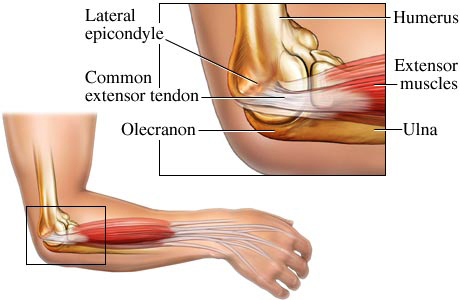
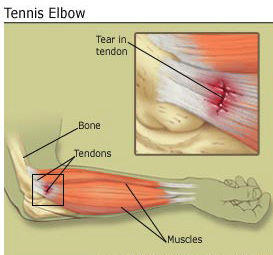
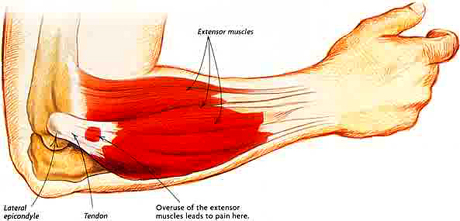
Symptoms
Anyone can be affected, but it is most commonly seen in 2 groups of people:
- Manual laborers : People who work with their hands are at greater risk of developing
tennis elbow. Jobs that may lead to it include plumbers, painters, gardeneres, carpenters
and so on.
- Sports participants : Especially racquet sport players are prone to developing tennis
elbow. About a third of regular players experience it at some point in their careers.
In addition to racquet sports, tennis elbow is seen in golfers, fencers and other
sports participants.
The person experiences:
- Recurring pain on the outside of the upper forearm just below the bend of the elbow;
occasionally, pain radiates down the arm towards the wrist.
- Pain caused by lifting or bending the arm or grasping even light objects such as
a coffee cup.
- Difficulty extending the forearm fully (because of inflammed muscles, tendons and
ligaments).
- Pain that typically lasts for 6 to 24 weeks; the discomfort can continue for as
little as 3 weeks or as long as several years.
Are special tests needed to diagnose
Not really any tests needed.
X-rays of patients who have the diagnosis of tennis elbow are almost always normal.
Other tests, such as EMG, are sometimes conducted if there is confusion about the
diagnosis.
Other causes of pain over the outside of the elbow include include instability of
the joint, elbow arthritis, and radial tunnel syndrome. The symptoms of these conditions
are usually distinct, but in some cases they can be confusing.
Life style tips
- PICK UP WHERE YOU LEFT OFF: You can ease back into your normal routine when your
elbow no longer bothers you. As a general rule, there should be no pain associated
with day to day tasks before you move on to something more demanding. Give yourself
time to see how your elbow reacts. Do not overdo it just because you do not feel
the pain right away.
- USE SOOTHING STROKES: Relaxing the surrounding muscles can take some of the pressure
off an aching elbow. Gently massage the full length of your forearm muscle from
your elbow to above your wrist, not just where you feel the pain.
- SAY "AHHH" WITH ICE: Freeze some water in a paper cup, the peel back the top of
the cup and rub the ice on your elbow in a circular motion for 5 to 7 minutes. Repeat
this treatment at least two times a day for the first five days that you have pain.
- MAKE SOME MUSCLE: Once your elbow is on the mend, gentle strengthening and stretching
exercises can help rehabilitate the joint and protect it from reinjury.
- BRACE YOURSELF: Try an elbow support. It prevents you from contracting the extensor
muscle when you move your hand. It also reminds you to give the injured area a rest.