Homeopathic treatment
Before delving into homeopathic treatment let us first discuss the conventional or allopathic treatment available.
Treatment in allopathy or conventional treatment
In allopathy or conventional system treatment is not considered necessary unless
the symptoms are bothersome unlike the homeopathic treatment which gives best results
in the initial stages or first degree prolapse and can stop the further progress
into second and third degree prolapse.
- HRT (hormone replacement therapy): Estrogen hormone is given in the form of suppository
ovules, cream or pessary and is inserted in the vagina. Side effects are as follows:
- Endometrial cancer if the estrogen therapy is not combined with progestin.
- Mood swings
- Severe bleeding
- This makes the hormone producing glands more sluggish as the body starts depending
on externally introduced hormones.
- Pessary: A vaginal pessary is an object inserted into the vagina to hold the uterus
in place. It may be a temporary or permanent form of treatment. Vaginal pessaries
are fitted for each individual woman. If your prolapse is severe, a pessary may
not work. Side effects are as follows:
- Pessaries can cause moderate to severe irritation
- Abnormal smelling discharge
- The pessary may rub on and irritate the vaginal wall (mucosa), and in some cases
may damage the vagina
- Pessaries may interfere with normal sexual intercourse by limiting the depth of
penetration
- Surgery: In some cases where pessaries fail, the only option in the conventional
or allopathic treatment is surgery. There are several types of surgery to treat
a severe prolapse of the uterus, including hysterectomy (surgical removal of the
uterus) and suspending the uterus. Some women may require treatment again in the
future for recurrent prolapse of the vaginal walls even after surgery. Complications
arising from surgery are as follows:
- Failure of the procedure to keep the pelvic organs supported
- Other complications are those of any major surgery such as wound infection, blood
clot to the lung, anesthetic complications, lung or bladder infections
- Injuries to adjacent organs such as the rectum, bowel, bladder urethra (tube from
the bladder to the outside) or ureter (tube from the kidney to the bladder)
Side effects of surgery are as follows:
- Psychological loss to the patient
- Surgically induced menopause
- Damage to surrounding organs
- Sudden onset of hot flashes
- Loss of libido or desire for sex
- Vaginal dryness
- Hormonal imbalances: weight gain, malaise, acne, unwanted hair growth, deeper voice
- Osteoporosis
- Sleep disruption, insomnia, night sweats
Homeopathy
Chronic and complicated diseases can easily be treated by the magical doses of homeopathic
medicines. There are special medicines which help in treating various female disorders
/ diseases including prolapsed uterus or uterine prolapse.
The most recent approach in treating is addressing the overall symptoms of this
disease and prescribing a remedy capable of normalizing unfavorable responses to
aggravating factors (cough, constipation, hormonal and so on). Homeopathy is a treatment
which treats the patient and leaves no side effects.
Research shows the high efficacy of homeopathic medicines on prolapsed uterus. Thus
a female can save herself from an embarrassing situation and can continue with her
professional and personal activities very easily.
How homeopathy works
- Action on the supportive structures of the pelvis: Medicines act
on the soft tissue structures vital to normal body functions, layers of muscles,
fibrous coverings called fasciae, and various ligaments and tendons and thus strengthen
the supportive structures of the pelvis which help keeping the uterus at a right
place. After menopause weakening of pelvic tissues due to the drop in the estrogen
levels can effectively be taken care of by treatment.
- Actions on the injured tissues during childbirth: During child
birth the supportive structures of the pelvis get injured. There are specific medicines
to combat injury of supportive tissues hence preventing prolapse of uterus. Medicines
work by increasing body’s own healing abilities and healing time is greatly diminished.
- Action on the various aggravating / risk factors: The various
risk factors like chronic cough, constipation, pelvic tumors, obesity can effectively
be taken care of with remedies thus preventing the further risk of developing prolapse
of uterus or uterine prolapse.
- Action on hormonal imbalances: The hormonal imbalances are
seen after menopause and are usually present in obese females. Properly selected
remedy has the capacity to correct hormonal imbalances by its action on the various
glands.
- Action on patients using pessaries: The pessary inserted in
the vagina to support the uterus may result in the irritation and abnormal smelling
discharge which can be dealt effectively by treatment. The vaginal injury caused
by a pessary can be taken care of by proper homeopathic medicines.
- Action after surgery: If surgery is the last option and cannot
be prevented, then it is highly recommended to continue the homeopathy treatment
to avoid post surgical complications.
- Early Diagnoses and homeopathic treatment rules out the option of surgery: Surgery
can be avoided if a patient comes in the early stages (first and second degree prolapse)
of the disease. The medicines control the further progress of the disease and prevent
the complications like urinary tract infections, ulcerations of vagina and so on.
So homeopathy saves a female from a surgical trauma which is physical, mental as
well as financial.
There are 134 homeopathy which give great relief. However, the correct choice and
the resulting relief is a matter of experience and right judgment on the part of
the doctor. The treatment is decided after thorough case taking of the patient.
Thus homeopathic treatment are tailor made unlike allopathy in which all patients
receive the same surgery or drugs although trade name may be different.
For online treatment, you may follow the following steps at Consult now.
*DISCLAIMER: There is no guarantee of specific results and the results can vary. None of the remedies mentioned including services, mentioned at HomeopathicTreatment4U.com, should be used without clearance from your physician or healthcare provider. We do not claim to cure any disease which is considered 'incurable' on the basis of scientific facts by modern medicine. We assure you of the best possible efforts for those who apply for online treatment. However, please note that we do not claim to cure each and every case, nor do we guarantee any magical cure. The website’s content is not a substitute for direct, personal, professional medical care and diagnosis.
What is prolapsed uterus or uterine prolapse
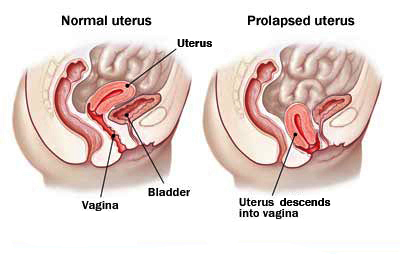
Prolapsed uterus is the descent of the uterus from its normal position in the vagina.
It refers to a collapsed uterus, or descended uterus, or other change in the position
of the uterus in relation to the surrounding structures within the pelvis.
The pelvis contains many soft tissue structures vital to normal body functions,
supported primarily by the diaphragms, layers of muscles, fibrous coverings called
fasciae, and various ligaments and tendons. These soft tissues of the pelvis derive
their ultimate support from the bony pelvis.
Uterine prolapse produces a sensation of pelvic discomfort, aggravated in the upright
position.
It is also known as pelvic relaxation or pelvic floor hernia.
This condition occurs more commonly in older women who have had multiple vaginal
births; it is seen also in younger women recently delivered.
Caucasian women are more commonly affected by uterine prolapse; African Americans
and Asians are affected less often.
Types
It may be of three types, depending on the severity:
- First degree prolpase occurs when the uterus sags downward into the upper vagina.
- Second degree prolapse occurs when the cervix is at or near the outside of the vagina.
- Third degree proplase (sometimes referred to as total prolapse) occurs when the
entire uterus extends outside the vagina.
Primary causes
- Childbirth : May injure supportive structures in the pelvis.
- Menopause : Causes estrogen levels to decrease. This drop in estrogen can cause
the weakening of pelvic tissues.
- Conditions leading to increased pressure in the abdomen such as chronic cough (with
bronchitis and asthma), straining (with constipation), pelvic tumors (rare), or
an accumulation of fluid in the abdomen.
- Obesity.
- Normal aging.
- Radical surgery in the pelvic area leading to loss of external support.
Symptoms
- A bulge in your vagina that ranges in size from quite small to very large.
- Discomfort or pressure in your pelvis or vagina.
- Difficulty having a bowel movement.
- Trouble emptying your bladder.
- Pain while intercourse.
- Lower back pain.
- Increased discomfort with long periods of standing.
- Improved discomfort with lying down.
- A feeling as if "sitting on a small ball."
Other conditions associated with prolapsed uterus or uterine prolapse
Cystocele
A herniation (or bulging) of the upper front vaginal wall where a part of bladder
bulges into the vagina, which may lead to urinary frequency, urgency, retention,
and incontinence.
Enterocele
The herniation of the upper rear vaginal wall where a small bowel portion bulges
into the vagina. Standing leads to a pulling sensation and backache and is relieved
when you lie down.
Rectocele
The herniation of the lower rear vaginal wall where the rectum bulges into the vagina.
This makes bowel movements difficult to the point that you may need to push on the
inside of your vagina to empty your bowel.
How is prolapsed uterus or uterine prolapse diagnosed
A pelvic examination with the woman bearing down will show how far the uterus comes
down. Uterine prolapse is mild when the cervix drops into the lower part of the
vagina. It is moderate when the cervix drops out of the vaginal opening.
The pelvic exam may show protrusion of the bladder in and front wall of the vagina
(cystocele) or rectum and back wall of the vagina (rectocele) into the vaginal space.
The ovaries and bladder may also be positioned lower in the pelvis than usual.
Specific conditions, such as ureteral obstruction due to complete prolapse, may
need an intravenous pyelogram (IVP) or renal sonography. Dye is injected into your
vein, and a series of x-rays are taken to view its progress through your bladder.
Ultrasound may be used to rule out other pelvic problems. In this test, a wand is
passed over your abdomen or inserted into your vagina to create images with sound
waves.
Complications
- Ulceration and infection of the vaginal walls may occur in severe cases of uterine
prolapse.
- Urinary tract infections and other urinary symptoms may occur because of a cystocele.
- Constipation and hemorrhoids may occur because of a rectocele.
Prevention
- One can strengthen the pelvic muscles by performing Kegel exercises to avoid prolapsed
uterus or uterine prolapse. It can be done by tightening pelvic muscles, as if trying
to stop the flow of urine. This exercise strengthens the pelvic diaphragm and provides
some support.
- Maintain a healthy weight.
- Avoid beverages that contain caffeine; they can increase the urge to urinate.
- Do not lift heavy objects; they can put pressure on your pelvic muscles.