Homeopathic treatment
Before delving into homeopathic treatment let us first discuss the conventional or allopathic treatment available.
There is no full proof conventional treatment of osteoarthritis (OA). Palliative
processes like pain killers which are frequently prescribed results in lot of side
effects. Some of the conventional or allopathic medicines used for treatment and
their side effects are as follows:
- Acetaminophen: Acetaminophen (Tylenol, others) can relieve pain,
but doesn't reduce inflammation. Acetaminophens can cause liver damage.
- NSAIDs: Nonsteroidal anti-inflammatory drugs (NSAIDs) can relieve
pain and reduce inflammation. NSAID side effects include ringing in your ears, cardiovascular
problems, and liver and kidney damage.
- Tramadol: Tramadol (Ultram) is a centrally acting analgesic that's
available by prescription. Tramadol has no anti-inflammatory effect, but can provide
pain relief. Tramadol may cause nausea and constipation.
- Stronger painkillers: Stronger pain killers such as codeine and
propoxyphene (Darvon) may be prescribed by allopathic physicians. Side effects include
nausea, constipation and sleepiness.
- Surgery: In severe cases surgery is required which is a physical,
mental and a financial trauma to the patient.
In contrast homeopathy can offer good relief to patients with osteoarthritis of knees or
degenerative joint disease especially those in the early stages of the disease.
The medication can help in controlling pain as well as improving the mobility of
the joints. Most patients notice a reduction in the pain and stiffness after commencing
homeopathy treatment with improved mobility of the joints.
Since osteoarthritis (OA) is a degenerative condition, it may not be possible to
reverse the changes that have already occurred at the microscopic level on the joints
but it is possible to slow down the further progress of the condition with the appropriate
remedies. Nothing like this can be achieved with allopathic / conventional medicines.
In advanced cases, symptoms can be palliated / suppressed with homeopathic medicines
thus saving you from a surgeon’s knife.
An important point to be noted about homeopathic treatment is that the medicines
can be continued for a long period (which is required in OA cases) without worrying
about any side effects. The medicines are completely safe, non-toxic and non habit
forming.
At the Division of Geriatric Medicine in the University of Pittsburgh School of
Medicine, a study clearly demonstrated that homeopathy medicines show positive response
in the treatment of osteoarthritis and rheumatoid arthritis.
How homeopathy helps
- The medicines help to reduce pain, swelling and improve the mobility of the affected
joint.
- The remedies prevent the further damage to the knees thus improving the quality
of life of the patient.
There are 353 homeopathy medicines which give great relief in osteoarthritis (OA)
or degenerative joint disease (DJD) or osteoarthrosis. However, the correct choice
and the resulting relief is a matter of experience and right judgment on the part
of the doctor. The treatment is decided after thorough case taking of the patient.
Thus homeopathic remedies are designer made unlike allopathy in which all patients
receive the same surgery or drugs although trade name may be different.
For online treatment, you may follow the following steps at Consult now.
*DISCLAIMER: There is no guarantee of specific results and the results can vary. None of the remedies mentioned including services, mentioned at HomeopathicTreatment4U.com, should be used without clearance from your physician or healthcare provider. We do not claim to cure any disease which is considered 'incurable' on the basis of scientific facts by modern medicine. We assure you of the best possible efforts for those who apply for online treatment. However, please note that we do not claim to cure each and every case, nor do we guarantee any magical cure. The website’s content is not a substitute for direct, personal, professional medical care and diagnosis.
What is osteoarthritis of knees (OA) / degenerative joint disease (DJD) / osteoarthrosis
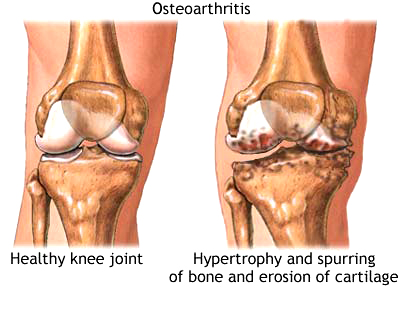
Osteoarthritis is a joint disease that causes the cushion layer between your bones
(called cartilage) to wear away. It can affect any joint in your body, and it is
the most common type of arthritis.
OA is a type of arthritis caused by inflammation, breakdown, and eventual loss of
cartilage in the joins.
Cartilage is a protein substance that serves as a "cushion" between the bones of
the joints. Among the over 100 different types of arthritis conditions, osteoarthritis
is the most common, affecting over 20 million people in the United States.
Before age 45, it occurs more frequently in males. After age 55 years, it occurs
more frequently in females. A higher incidence exists in the Japanese population,
while South African blacks, East Indians, and Southern Chinese have lower rates.
Classification & causes
Osteoarthritis (OA) can be classified into primary or secondary osteoarthritis depending
upon the cause of OA:
Primary Osteoarthritis (OA)
Primary osteoarthritis is mostly related to aging. With aging, the water content
of the cartilage increases, and the protein makeup of the cartilage degenerates.
Eventually, cartilage begins to degenerate by flaking or forming tiny crevasses.
In advanced cases, there is a total loss of cartilage cushion between the bones
of the joints. Repetitive use of the worn joints over the years can irritate and
inflame the cartilage, causing joint pain and swelling. Loss of the cartilage cushion
causes friction between the bones, leading to pain and limitation of joint mobility.
Inflammation of the cartilage can also stimulate new bone outgrowths (spurs, also
referred to as osteophytes) to form around the joints. Osteoarthritis occasionally
can develop in multiple members of the same family, implying a hereditary (genetic)
basis for this condition.
Secondary Osteoarthritis (OA)
Secondary osteoarthritis is caused by another disease or condition. Conditions that
can lead to it include obesity, repeated trauma or surgery to the joint structures,
abnormal joints at birth (congenital abnormalities), gout, diabetes, and other hormone
disorders.
Heredity plays an important role. Members of a family are seen to be more effected
than people without a family history.
Symptoms & signs
- Severe knee pain that limits your everyday activities, including walking, going
up and down stairs, and standing up from a chair. You may find it hard to walk more
than a few blocks without significant pain and you may need to use a cane or walker.
- Moderate or severe knee pain while resting, day or night.
- Chronic knee inflammation and swelling that doesn't improve with rest or medications.
- Knee deformity (a bowing in or out of your knee).
- Knee stiffness (inability to bend and straighten your knee).
- A crunching or grinding sound (crepitus or crackling) during the movement of the
joint.
Osteoarthritis (OA) causes the formation of hard, bony enlargements of the small
joints of the fingers. Classic bony enlargement of the small joint at the end of
the fingers is called a Heberden's node, named after a very famous British doctor.
The bony deformity is a result of the bone spurs from the osteoarthritis in that
joint.
Another common bony knob (node) occurs at the middle joint of the fingers in many
patients with osteoarthritis and is called a Bouchard's node. Osteoarthritis of
the joint at the base of the big toe of the foot leads to the formation of a bunion.
Diagnosis
There are no blood tests for the diagnosis. Blood tests are performed to exclude
diseases that can cause secondary osteoarthritis, as well as to exclude other arthritis
conditions that can mimic osteoarthritis.
X-rays:X-rays of the affected joints can suggest osteoarthritis. The common X-ray
findings include loss of joint cartilage, narrowing of the joint space between adjacent
bones, and bone spur formation.
Joint fluid analysis:A small quantity of fluid from the affected joint may be removed
(arthrocentesis) for testing in a laboratory. It can detect any infection or the
presence of gout which can also cause knee pain.
Arthroscopy:This is a procedure in which a tiny camera is used to visualize the
interior of the joint. During arthroscopy, small incisions are made around the joint
and a tiny camera is inserted to see the inside of the joint as well as to repair
any abnormality that may be found.
Diet
- Appropriate levels of vitamin C, D, E, antioxidants, and omega-3 fatty acids have
protective properties against osteoarthritis.
- Dietary carotenoids like beta-cryptoxanthine, lutein and lycopene, found in orange
and green vegetables and tomatoes reduce the risk of knee osteoarthritis. However,
delta and gamma tocopherols, found in soyabean, palm, and other oils, double the
risk of knee osteoarthritis.
- Herbs such as curcumin are good for reducing inflammation.
- Fresh pineapple has also been shown to have anti-inflammatory properties.
- Avoid adrenal stimulants such as tea, coffee, sugar and refined carbohydrates.
- Avoid carbonated drinks such as coke, pepsi and so on due to their phosphoric acid
content.
Home treatment
- Exercise regularly : This is especially useful if you have knee osteoarthritis (OA).
Exercising strengthens the leg muscles that support the knee and they absorb shock
before it gets to the knee.
- Wearing comfortable footwear, preferably cushioned ones, helps a lot since they
properly support your weight especially if you have OA affecting your knees, hips
or spine.
- Be gentle in your movements, don’t exert any of your joint too much or put excessive
pressure on any joint.
- Try hot or cold compresses on the affected joint. In an acutely inflamed joint,
avoid hot compresses.
- Splints and braces can be used to support weakened joints.