Homeopathic treatment
Before delving into homeopathic treatment let us first discuss the conventional or allopathic treatment available.
Allopathic mode of treatment
The treatment comprises of antibiotics to control local infection, decongestants
and steroids.
Conservative treatment can be given in the form of oral or topical steroids, antihistaminics
and decongestants. Though these are not curative but only control the situation.
Cases refractory to conservative treatment are dealt with surgically by performing
functional endoscopic sinus therapy.
The ethmoidal polypoid disease is essentially an allergic condition. Eary polyposis
may respond to medical treatment, but well established polyposis will require surgical
treatment. Recurrences are common even after surgical removal of the polyp as the
underlying cause is nasal allergy.
Allopathic treatment gives only immediate symptomatic relief and when this fails
to control significant symptoms with repeated or prolonged courses of steroid and
antibiotic therapy, or when total nasal obstruction occurs, the allopathic doctor
refers the patient to surgery.
Since allergy is often the root cause, high recurrence rate remains a feature of
allergic nasal polyposis. Other causes of failure of surgery include inadequate
surgery, aggressive nature of polyps, predisposing local factors or improper post
operative care.
It is a recurrent disease that may be very frustrating to both the patient and the
doctor.
How does homeopathy helps
Homeopathic treatment for those who suffer from nasal polyps can be a big boom.
It can help them save from the surgeon's knife. Not only does it slowly and steadily
shrinks the nasal polyps, it also helps in stopping their recurrences by treating
the underlying causes such as allergies, asthma and chronic cold.
Homeopathy is a holistic system of medicine. This means that it treats the body
as a whole. Detailed mental and physical symptoms of the whole being are taken into
consideration while prescribing. This form of treatment is called constitutional
treatment.
In cases where the nasal polyps are due to deep seated chronic disorders like asthma
or allergies this constitutional treatment is usually taken up by the doctor.
Timely administered homeopathic medicines help avoid surgery and its inherent complications.
Moreover, it is very common for the condition to recur even after surgery. Homeopathy
is therefore highly recommended for people who have had surgery done to remove nasal
polyps as the treatment would have a preventive effect, by which chance of recurrence
is minimized.
In short the treatment is targeted towards the root cause of the illness and hence
the disease is treated from the core. Homeopathy believes in treating the patient
and not just the disease.
There are 70 remedies which give great relief. However, the correct choice and the
resulting relief is a matter of experience and right judgment on the part of the
doctor. The treatment is decided after thorough case taking of the patient. Thus
medicines are tailor made unlike allopathy in which all patients receive the same
drugs or surgery although trade name may be different.
For total cure the treatment must be taken seriously for about 2 to 3 years depending
upon the number and size of nasal polyps.
For online treatment, you may follow the following steps at Consult now.
What are nasal polyps
If you constantly suffer from blocked or a stuffy feeling in the nose, reduced or
complete loss of smell and constantly running or dripping of mucus in the nose,
there are chances that these symptoms could be a result of a polyp in your nose.
The word 'polyp' which is originally Greek has undergone latinization and means
(poly-pous) many footed.
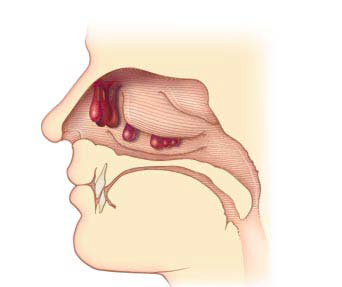
Nasal polyps are defined as pearly white, painless, prolapsed pedunculated parts
of the nasal mucosa. They are unique in their position and their composition.
They are fleshy growths on the linings of the nose or sinuses. They vary in size
and are shaped like a tear drop, with a narrow neck joined to the nasal lining.
Nasal polyps are non cancerous growths which occur due to an inflammation in the
mucous membrane (living) of the nose and sinuses. They are divided into 2 main varieties:
- Bilateral ethmoidal polyp.
- Antrochoanal polyp.
Causes
Nasal polyps occur due to chronic inflammation in the lining of the nose. Although
the reason for this chronic inflammation is not clear but they tend to occur more
in those who suffer from chronic nasal problems like sinusitis, chronic colds, asthma
and nasal allergies.
Children with cystic fibrosis also tend to develop nasal polyps.
Chronic inflammation causes the blood vessels in the lining of the nose to become
more porous, causing them to accumulate lot of water in the cells. When over a period
of time gravitational force acts on these heavy water-laden mucus lining, nasal
polyps develop.
Overuse of aspirin or other salicylate medication can cause polyps to form.
Symptoms
- Nasal polypsis is a disease affecting the adults. When children below 10 are affected,
cystic fibrosis needs to be ruled out.
- Small polyps cause no symptoms at all.
- Larger ones can cause obstruction in the air passages of the nose causing stuffiness
or blocked sensation.
- Partial or total loss of sense of smell.
- When they obstruct the discharge from the sinus openings, polyps lead to chronic
sinusitis.
- Sneezing and watery nasal discharge due to associated allergies.
- Post nasal drip.
- Mass protruding in the nostril.
- Large polyps can cause difficulty in breathing while lying down, causing the patient
to breathe from the mouth. Patients with very severe polyposis may also present
with obstructive sleep apnea.
- Asthma and aspirin sensitivity may be present in patients with ethmoidal polyps.
- Unilateral nasal obstruction may be present in patients with an antrochoanal polyp.
- Headache, snoring and a permanent runny nose, facial pain, hyponasal voice and cough.
- Nosebleeds.
Diagnosis
- Diagnosis can be easily made on clinical examination.
- Anterior rhinoscopy with decongestant usually reveals the disease.
- X-ray paranasal sinuses may show opacity of the involved antrum.
Home remedies
- To help decongest a stuffy nose and keep the mucous membranes from swelling and
forming polyps, try hot baths or showers.
- Try steam inhalations : Run very hot hoter in a sink until steam builds up. With
the water running, lean over the sink, and drape a towel over your head to trap
the steam. Breathe deeply through your mouth and nose for 5 to 10 minutes. Repeat
several times a day.