Homeopathic treatment
The goal of treatment is to reduce your symptoms and speed up the healing of the
skin lesions due to lichen planus.
Before delving into homeopathic treatment let us first discuss the conventional or allopathic treatment available.
Allopathy or conventional medicine offers a range of options which include:
- Antihistamines.
- Lidocaine mouth washes which may numb the area temporarily and make eating more
comfortable in oral lichen planus.
- Topical corticosteroids or oral corticosteroids may be prescribed to reduce inflammation
and suppress immune response.
- Topical retinoic acid cream and other ointments or creams are prescribed to reduce
itching and inflammation.
- Occlusive dressings may be placed over topical medications to protect the skin from
scratching.
- Ultraviolet therapy.
Cortisone is the most commonly prescibed medicine but unfortunately, it is not the
curative medicine. The problem with the use of cortisone is that it gives temporarily
relief, as long as you use it. Another problem is that the disease comes back after
stopping cortisone and resurfaced diseases are most difficult to handle then when
it started, as it becomes resistant.
Patient's awareness about this fact and active cooperation helps us to overcome
the crisis and treat the disease. Use of cortisone makes the lichen planus more
resistant. Cortisone can even increase lichen planus in some cases.
Cortisone, being an immunosuppresive therapy, suppresses lichen planus lesions for
some time without curing it. As a result, some eruptions get better after using
cortisone, but more eruptions may appear elsewhere. Cortisone is not effective as
a long term treatment, so SAY NO TO STEROIDS.
The homeopathic way of treatment
Homeopathy offers research proven and highly effective treatment for lichen planus
which has been scientifically documented. Contrary to the allopathic treatment which
is governed by the use of cortison or steroids, homeopathic treatment is extremely safe and long lasting.
The treatment is based on the individual case study of the patient's disease, its
causes, its spread, the area affected, the genetic pattern, mindset and so on. The
medicines thus designed are addressed towards correcting the immunity.
During the course of homeopathy treatment of any disease in which cortisone in any
form is being used, the major challenge is to handle the period of cortisone or
steroid withdrawl. Slowly the homeopathic remedies take control of the situation
and the steroids are tapered off. This may take time. The amount of time it takes
to overcome steroid or cortisone withdrawl syndrome depends on the following: amount
of cortisone or steroid used, duration of cortisone or steroid use, severity of
disease, duration of the disease.
The duration of treatment varies from case to case depending on the following factors:
- Duration of lichen planus.
- Area affected (skin, mouth, genitals, nails, scalp).
- Extent of spread (only skin or only mouth or skin with mouth and so on).
- General health and associated diseases.
Lichen planus is a chronic disease, will require a long and planned treatment. There
is no short cut.
Why homeopathy
- It offers excellent treatment which has a success rate of over 85%.
- It corrects the altered immune system hence gives deep level healing.
- It offers long lasting cure.
- It is absolutely harmless, safe and non-toxic.
There are 18 homoeopathy remedies which give great relief in lichen planus. However,
the correct choice and the resulting relief is a matter of great experience and
right judgment on the part of the doctor. The treatment is decided after thorough
case taking of the patient. Thus medicines are specially designed for a particular
patient unlike allopathy.
For online treatment, you may follow the following steps at Consult now.
*DISCLAIMER: There is no guarantee of specific results and the results can vary. None of the remedies mentioned including services, mentioned at HomeopathicTreatment4U.com, should be used without clearance from your physician or healthcare provider. We do not claim to cure any disease which is considered 'incurable' on the basis of scientific facts by modern medicine. We assure you of the best possible efforts for those who apply for online treatment. However, please note that we do not claim to cure each and every case, nor do we guarantee any magical cure. The website’s content is not a substitute for direct, personal, professional medical care and diagnosis.
What is lichen planus
The term lichen planus is derived from 2 words - lichen and planus. Lichen refers
to a tree moss while planus is latin for flat. Thus the literal meaning of lichen
planus is like a flat tree moss.
LP is a very common skin disorder but it is a very dangerous skin condition. There
is recurrent rash that is due to inflammation. This rash can be very itchy and stubborn.
The rash is characterized by small. flat-topped, many-sided bumps that can grow
together into rough, scaly patches on the skin.
It usually involves the wrists, ankles, genitals and mouth but can affect any part
of the body. It may cause a small number of skin lesions or less often affect a
wide area of the skin and mucous membranes.
It occurs most often in men and women between the ages 30 and 70 years. It is uncommon
in very young and elderly. All racial groups seem susceptible to lichen planus.
Does lichen planus spread by touch? Is it contagious?
It is not caused by germs, bacteria, virus or fungus. So, it does not spread by
touch, sharing utensils or physical contact.
What lichen planus is not?
To understand what lichen planus is, it is important to note what the disease is
not. LP is not an infectious disease. It is impossible to catch LP from someone
or to give it to someone else. The disease is not a form of cancer, it does not
appear to be inherited, and it is not related to nutrition.
Causes
The exact cause is unknown, but is likely to be related to an allergic or immune
reaction. LP has been known to develop after exposure to potential allergens such
as medications, dyes, and other chemical substances.
Symptoms are increased with emotional stress, possibly because of changes in immune
system during stress. Stress has great bearing to lichen planus.
Chemicals or medications associated with development of LP include gold (used to
treat rheumatoid arthritis), antibiotics, arsenic, iodides, chloroquinone, quinacrine,
quindine, antimony, phenothiazines, diuretics such as chlorothiazide, and many others.
Lichen planus may be associated with several other disorders, most notably hepatitis
C.
Symptoms
Itching in lesion - may be mild to severe.
Lichen planus of the skin
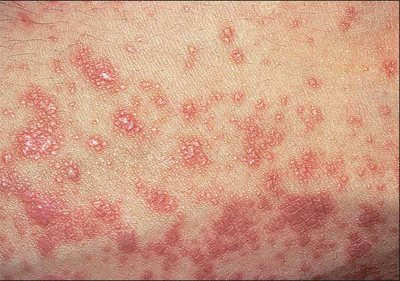
Lichen planus of the skin is characterized by reddish-purple, flat-topped bumps
that may be very itchy. Some may have a white lacy appearacne called Wickham's striae.
They can be anywhere on the body, but seem to favor the inside of the wrists and
ankles. It can also occur on the lower back, neck, legs, genitals, and in rare cases,
the scalp and nails. LP on legs is usually darker in appearance. There may be thick
patches especially on the shins. Blisters are rare except in special cases. While
the typical appearance of LP makes the disease somewhat easy to identify, a skin
biopsy may be needed to confirm the diagnosis.
Lichen planus of the skin causes severe itching. As it heals, lichin planus often
leaves a dark brown discoloration on the skin. These stains may eventually fade
with time and treatment.
Lichen planus of the mouth
Lichen planus of the mouth most commonly occurs inside of cheeks, but can affect
the tongue, lips, and gums. Oral LP is more difficult to treat. About 1 in 5 people
who have oral lichen planus also have skin lichen planus.
"Oral lichen planus typically appears as patches of fine white lines and dots. More
severe forms of oral lichen planus can cause painful sores and ulcers in the mouth.
A biopsy of affected tissue may be needed to confirm a diagnosis.
Patients with oral LP may be at a slightly increased risk of developing oral cancer.
Because of this increased risk, it is wise to discontinue the use of alcohol and
tobaccco products, which also increase the risk. Regular visits to the doctor for
an oral cancer screening is recommended.
Lichen planus of the genitals
Lichen planus of the genitals is less common in men than women. About 1 in 5 women
have vulvar or vaginal LP. It may cause red areas or open sores causing pain, especially
with sexual intercourse.
Nail involvement
Nail changes have been observed in lichen planus. The majority of nail changes result
from damage to the nail matrix, or nail root. Nail changes can occur with or without
skin involvement.
Nail changes associated include longitudinal ridging and grooving, splitting, nail
thinning, and nail loss. In severe cases, the nail may be temporarily or permanently
destroyed.
Scalp involvement
Lichen planus can affect hairy areas such as the scalp in rare cases. This is called
lichen planopilaris, and can lead to redness, irritation, and in some cases, permanent
hair loss.
How is lichen planus diagnosed
Usually, it is relatively straight forward to diagnose. Physicians can make the
diagnosis in typical cases simply by looking at the rash. If necessary, a skin biopsy
may be done to help confirm the diagnosis. Persistent oral or vaginal lichen planus,
with spots that thicken and grow together, can sometimes be difficult to distinguish
clinically from whitish precancerous plaques called leukoplakia. A biopsy can be
helpful in this situation.
Widespread LP with erosions in the mouth can also be confusing. A biopsy may be
required to distinguish this from other conditions such as candidiasis (yeast infection),
carcinoma (cancer), and ulcers in the mouth (aphthous ulcers).